A fridge freezer that has stopped cooling creates a different type of repair decision from a washing machine that will not drain. The F-Gas engineer versus general technician question matters because cooling faults can involve electrical diagnosis, sealed refrigeration systems and refrigerants that must be handled correctly. Choosing the right professional protects your appliance, your home and your money.
For many faults, a capable appliance technician can find the cause quickly and complete a safe repair. But if work may involve the refrigerant circuit, the person attending needs the relevant certification, equipment and competence. The key is not paying for a grander job title. It is making sure the engineer is qualified for the fault in front of them.
What a general appliance technician can do
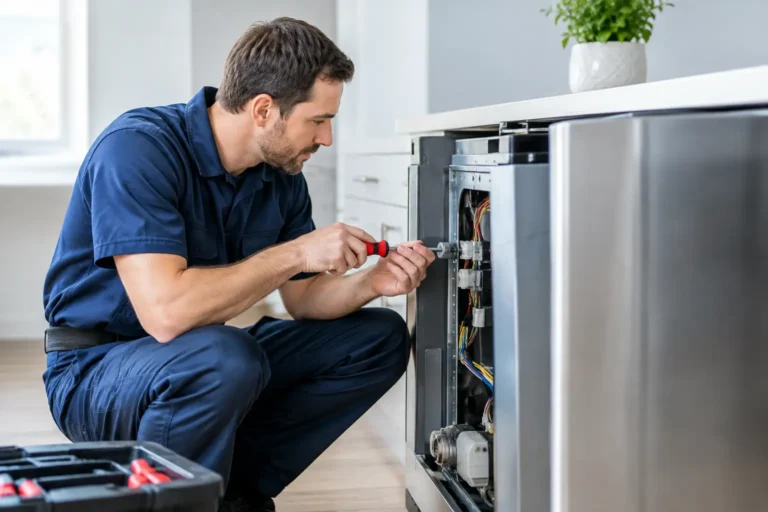
A general domestic appliance technician is trained to diagnose and repair common faults across appliances such as washing machines, dishwashers, ovens, tumble dryers and fridge freezers. Their work often covers electrical supply problems, controls, sensors, motors, pumps, fans, heaters, door seals, drainage issues and mechanical components.
On a fridge freezer, that can include replacing a faulty thermostat or temperature sensor, repairing a damaged door hinge, changing an evaporator fan, resolving a defrost fault, investigating an error code or testing a failed control board. These jobs can restore normal operation without opening the sealed cooling circuit.
A good general technician should still have the diagnostic tools and manufacturer knowledge to identify when a cooling fault is likely to be more involved. That judgement is valuable. There is little point fitting a sensor or control board if the actual problem is a refrigerant leak, compressor failure or restriction within the system.
The limitation is straightforward: a general technician should not attempt work they are not trained, equipped or certified to carry out. Refrigerant recovery, leak diagnosis and repairs to a sealed refrigeration system are specialised tasks, not an extension of routine electrical appliance repair.
When an F-Gas engineer is the right choice
An F-Gas-qualified engineer has training and certification relating to fluorinated refrigerant gases and the safe handling of relevant cooling systems. Where regulated refrigerant is present, the work can include recovery, evacuation, leak testing, recharging and records required under applicable rules.
For a household, the practical question is usually whether the sealed system needs to be opened or its refrigerant charge assessed. Warning signs include a fridge that runs constantly but remains warm, a freezer that only cools in one area, visible oily residue around refrigeration pipework, repeated loss of cooling after a previous repair, or a compressor that is running but unable to bring temperatures down.
American-style fridge freezers can particularly benefit from specialist assessment. They combine more complex air-flow arrangements, ice and water systems, electronic controls and, in some cases, a more demanding cooling configuration. A technician may need to rule out fan, defrost or control faults first, but sealed-system work calls for the correct qualifications and equipment.
An F-Gas qualification is not simply a badge to display on a website. It indicates that the engineer understands the environmental and safety responsibilities involved in handling covered refrigerants. It also supports a more reliable diagnosis, because the engineer can test the cooling circuit properly rather than guessing from surface symptoms.
F-Gas does not describe every fridge repair
This is where the comparison needs some care. “F-Gas engineer” is widely used as a shorthand for a refrigeration specialist, but not every domestic fridge freezer contains an F-Gas refrigerant. Many modern household units use R600a, a hydrocarbon refrigerant. It is not an F-Gas, but it is flammable and demands appropriate specialist competence and safe working methods.
That means homeowners should avoid relying on a label alone. Ask whether the engineer is qualified and equipped to work safely on the refrigerant used in your specific appliance. The refrigerant type is normally shown on the appliance rating plate, often inside the fridge compartment or at the rear of the unit.
Equally, not every lack-of-cooling call-out requires refrigerant work. A blocked condenser area, failed fan, defective thermistor, heater fault or damaged door gasket can all affect temperature performance. An organised diagnostic process prevents an unnecessary sealed-system repair and gives you a clearer answer on whether repair is worthwhile.
F-Gas engineer versus general technician: the real difference
The most useful distinction is scope of work. A general technician deals with a wide range of appliance faults and is often the right person for non-refrigerant problems. An F-Gas or refrigeration-qualified engineer is needed when the job involves a sealed system, refrigerant handling or specialist cooling diagnosis.
There is overlap. Many experienced refrigeration engineers are also strong all-round appliance technicians, while some general appliance engineers have specialist cooling credentials. For a customer, the best outcome is an engineer whose skills match the fault rather than a one-size-fits-all booking.
Price should reflect this difference honestly. Sealed-system repairs can take longer, require specialist equipment and may involve parts such as compressors, driers or valves. In some cases, particularly with an older integrated fridge or an appliance with a failed compressor, replacement may be better value than repair. A trustworthy engineer will explain that before committing you to major work.
Questions to ask before booking a fridge freezer repair
You do not need technical knowledge to make a sensible booking. Start by explaining the symptoms clearly: whether the appliance has stopped cooling completely, whether the freezer still works, whether there is frost build-up, whether you can hear the compressor running and whether an alarm or error code is displayed.
Then ask whether the company can diagnose sealed-system faults and whether the attending engineer has the relevant refrigerant certification and safety training. It is also reasonable to ask how pricing works if the diagnosis identifies a major refrigeration fault, and whether parts and labour come with a written warranty.
For a busy household, practical service standards matter as much as technical ability. A defined arrival window, a fixed-price quote before work begins and a no-fix-no-fee policy remove much of the uncertainty that makes appliance repairs frustrating. DBS-checked engineers and genuine parts provide further reassurance, especially where a repair is being arranged for a tenant, elderly relative or rental property.
Do not ignore a cooling fault
A fridge that is not holding a safe temperature can lead to wasted food quickly. If chilled food feels warm, move perishable items to another working fridge where possible and avoid repeatedly opening the door. Do not try to puncture ice, bend pipework or use improvised tools around the rear of the appliance. This can damage the system and, with flammable refrigerants, create an avoidable safety risk.
Switching the appliance off and on again may occasionally reset an electronic control issue, but it will not repair a refrigerant leak or failed compressor. If the unit is making unusual clicking noises, smells of burning, trips the electrics or shows signs of damaged wiring, unplug it if safe to do so and arrange professional help.
Choosing a repair service with the right cover
The best repair company will not send an unsuitable engineer simply to fill an appointment. It should ask enough questions at booking to identify whether you are reporting a routine appliance fault or a possible refrigeration problem. Clear photos of the rating plate, error display and internal frost pattern can help the team prepare before arrival.
At CrownTech Appliances, fridge freezer repairs are assessed with this distinction in mind, so customers are not left guessing whether a standard electrical repair is enough or specialist cooling expertise is needed. The aim is a clear diagnosis, a transparent recommendation and no pressure to proceed where replacement is the more sensible option.
If your fridge freezer is warm, noisy or running without properly cooling, describe the symptoms when you book and ask for the engineer whose qualifications fit the fault. That small step gives you the best chance of a safe repair and a working kitchen without unnecessary delay.