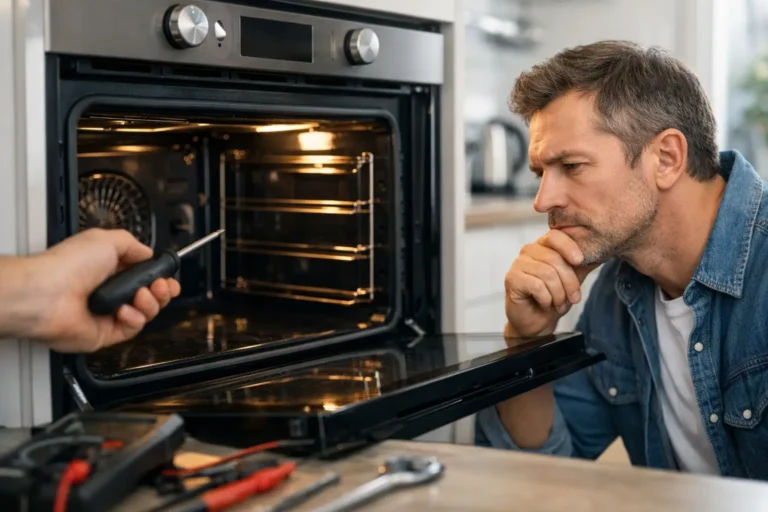
A Sunday roast that is raw in the middle, a tray of biscuits browned on one side, or an oven that simply will not heat can throw a busy household off course quickly. Knowing the best signs your oven needs repair helps you act before a minor fault becomes a complete breakdown, a spoiled meal or, in some cases, a safety concern.
An oven does not need to be completely dead to need attention. Temperature control, heating elements, door seals and electrical connections can all deteriorate gradually. The practical question is not just whether something feels wrong, but whether the fault is consistent, worsening or affecting safe use.
The best signs your oven needs repair
1. Food cooks unevenly or takes far longer than usual
Uneven cooking is one of the clearest early warnings. You may find that food at the back of the oven burns while the front remains pale, or that a recipe that normally takes 30 minutes now takes closer to an hour. Turning trays may help temporarily, but it does not solve the underlying problem.
In fan ovens, this can point to a failing fan motor, a damaged fan element or poor air circulation. In conventional electric ovens, one heating element may no longer be working correctly. A thermostat fault can also cause the appliance to run too cool, even when the display says it has reached temperature.
Before assuming the oven is faulty, check that shelves are positioned sensibly and that large trays are not blocking the fan cover. If the problem continues across different meals and settings, arrange a diagnosis. Guessing at the temperature and extending cooking times is inconvenient and can be unsafe when preparing meat or reheating food.
2. The oven does not reach, or hold, the set temperature
If you set the oven to 180°C but it behaves more like 140°C or 220°C, the thermostat, temperature sensor or control board may be at fault. Some temperature variation is normal, as ovens cycle their heat to maintain an average. Wide swings, however, are not.
An inexpensive oven thermometer can help confirm what is happening, but it should be used as an indicator rather than a final diagnosis. If the temperature is consistently wrong by a noticeable margin, or drops during cooking, a qualified engineer can test the components accurately.
This fault is particularly frustrating because the oven may appear to work. Lights come on, the timer runs and heat is present, yet cooking results become unreliable. A repair is often more sensible than replacing an otherwise sound built-in appliance.
3. One function works, but another does not
Many ovens have separate elements and circuits for fan cooking, grilling and conventional top-and-bottom heat. If the grill works but the fan oven stays cold, or the oven heats but the grill no longer does, do not assume the appliance is beyond repair.
A failed element is a common cause and is often repairable with the correct genuine replacement part. Other possibilities include a faulty selector switch, wiring issue or relay on the electronic control board. The exact cause depends on the make, model and symptoms, which is why a proper test matters before any parts are fitted.
Avoid repeatedly switching the faulty setting on and off in the hope it will recover. If an element has failed, continued use can sometimes trip the electrics or place extra strain on other components.
4. The oven trips the consumer unit
An oven that trips the circuit breaker or RCD needs prompt attention. It may happen as soon as the oven is turned on, when a particular cooking mode is selected, or only after the appliance has warmed up. A damaged heating element is a frequent cause because insulation can break down as the element heats.
Resetting the switch once after everything has cooled may help identify whether the issue is repeatable, but do not keep resetting it and carrying on. Repeated tripping indicates an electrical fault that should be inspected by a qualified appliance engineer. Do not remove panels or attempt electrical repairs yourself.
If you notice burning, smoke, sparks or a hot electrical smell, switch the appliance off at the isolator if it is safe to do so and stop using it. For a gas oven, any smell of gas requires immediate caution: turn off the gas supply if safe, ventilate the room, avoid flames or electrical switches, and contact the appropriate emergency service or a Gas Safe registered engineer.
5. The door will not close properly or the glass is damaged
A loose, misaligned or poorly sealed oven door wastes heat and makes cooking less efficient. You may notice steam escaping around the edges, unusually hot cabinetry, or food taking longer to cook. Often, worn hinges or a flattened door seal are responsible.
Do not ignore cracked door glass, even if the oven still appears usable. Oven glass is designed to withstand high temperatures, but a crack can spread under heat and the panel can fail. A door that drops suddenly when opened also deserves attention, particularly in homes with children.
Cleaning the seal gently can remove grease that prevents a proper close, but never use sharp tools or harsh abrasives. If the seal is split, brittle or coming away, replacement is the sensible option.
6. Controls, clock or display behave unpredictably
A flashing clock after a power cut is usually simple to resolve. On many models, the oven will not heat until the time has been reset or the appliance has been taken out of automatic cooking mode. Check the instruction manual for this first.
Persistent display faults are different. Buttons that do not respond, settings that change on their own, an error code that returns, or a display that goes blank can signal a failing control panel, timer module or circuit board. These faults can be intermittent at first, which makes them easy to postpone.
If the controls are unreliable, avoid leaving the oven unattended while it is operating. An engineer can determine whether the fault lies with the interface, wiring or electronic board, rather than replacing expensive parts on assumption.
7. You can hear unusual noises
A fan oven normally makes a steady whirring sound. Rattling, scraping, loud humming or a fan that starts and stops may indicate a worn motor, loose fan blade or failing cooling fan. The cooling fan is easy to overlook, but it protects the controls and surrounding cabinetry by moving heat away from the appliance.
A popping sound can sometimes be normal as metal expands during heating. A sharp bang followed by loss of heat, a flash inside the cavity, or a burning smell is not normal and can indicate an element failure. Switch the oven off and arrange a repair rather than using another setting to work around it.
8. There is visible damage inside the oven
Blistered enamel, exposed wiring, burnt terminals, a warped shelf support or a damaged element are all reasons to stop and assess the appliance. Do not touch an element or internal wiring, even when the oven is off, until it has been isolated from the power supply.
It is worth distinguishing cosmetic wear from functional damage. Light staining or surface marks may be unsightly but harmless. Deep enamel damage, however, can worsen with heat and cleaning chemicals. An engineer can advise whether a component repair is worthwhile or whether replacement is the better financial decision.
9. The oven is old, but the fault is limited
Age alone does not mean replacement is necessary. A well-maintained oven with a failed element, hinge, seal or thermostat can often be repaired economically. The decision depends on its condition, the availability and price of parts, its history of faults and the cost of a comparable replacement.
Replacement may make more sense when an older appliance has repeated electronic faults, extensive internal damage or a repair cost that approaches the price of a reliable new model. For built-in ovens, factor in installation and cabinetry compatibility as well, not just the price on the ticket.
What to do before booking an oven repair
Start with the safe basics: check the power supply, reset the clock after a power cut, confirm the child lock is not active and make sure the oven is not set to delayed start. Note any error code, which function fails, whether the fault occurs immediately or after heating, and the appliance model number. These details make diagnosis faster and help prevent unnecessary parts being ordered.
Do not dismantle the oven, bypass a tripped breaker or continue using it if there are signs of electrical damage. An oven combines high temperatures, mains electricity and, in some properties, gas connections. A professional diagnosis is the low-risk route when the fault affects heat, controls or electrical safety.
For households across West London, CrownTech Appliances provides in-home oven diagnosis with clear fixed-price quotes, DBS-checked engineers and a 12-month written warranty on parts and labour. Same-day availability can be particularly useful when an oven is needed for family meals, tenants or a managed property.
A working oven should be something you can rely on without second-guessing every meal. If the fault is repeatable, worsening or affecting safety, booking a repair early is usually the calmest and most cost-effective next step.