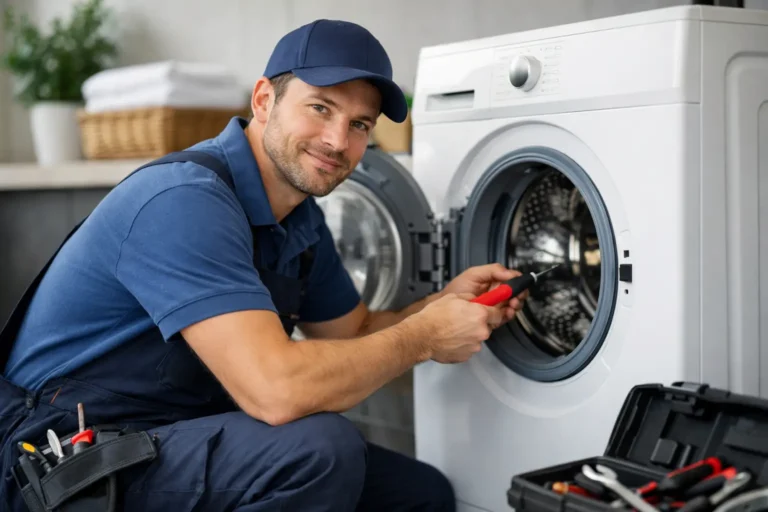
A washing machine rarely fails at a convenient moment. It stops mid-cycle, leaves a drum full of water, or starts making a noise that clearly means something is wrong. At that point, most households ask the same question: should you repair or replace washing machine problems, and how do you know which option will actually save you money?
The right answer depends on more than the headline repair cost. Age matters, but so do the fault itself, the brand, the machine’s condition overall, and whether the repair gives you another few reliable years or only delays a second breakdown. If you want a sensible decision rather than a guess, it helps to assess the machine the way an engineer would.
When repair is usually the better option
In many cases, repair is the straightforward choice. If the machine is under around eight years old, has been reliable up to now, and the fault is limited to one replaceable component, repair often makes far more sense than buying new.
Common examples include a failed pump, worn door lock, broken heating element, faulty drain hose, damaged seal or carbon brushes on older motor systems. These are real faults, but they do not automatically mean the appliance is finished. A professional diagnosis can separate an isolated component failure from a wider wear issue.
Brand quality also matters. A well-built Bosch, Miele, Siemens, Neff or LG machine may still be worth repairing at an age where a cheaper model would not be. Better machines tend to have stronger core components, better parts support and longer realistic lifespans. Replacing a good appliance too early can be the more expensive decision in the long run.
Repair is also attractive when the machine fits a kitchen layout, stacked utility area or integrated cabinet setup. Replacing an appliance is not always as simple as swapping one box for another. Delivery delays, installation costs, removal charges and awkward sizing can all turn a replacement into a bigger job than expected.
When it makes more sense to replace a washing machine
There are cases where replacement is the safer and more economical route. If the drum bearings have failed on an older machine, the outer drum is damaged, the control board has burnt out, or the appliance has developed multiple faults at once, repair costs can climb quickly.
Age is a useful guide, though not a rule. Once a machine reaches around 10 to 12 years old, especially if it has had previous repairs, any new major fault needs a harder look. You are no longer paying only for today’s repair. You are also gambling on what might fail next.
Replacement is often the better option if the machine has rust, recurring leaks, severe vibration damage, or signs of electrical burning. Those are not minor wear issues. They suggest the appliance is deteriorating overall, and putting more money into it may not deliver dependable results.
Energy and water efficiency can play a part too, although this should not be overstated. A newer model may be cheaper to run, but the savings usually build gradually rather than overnight. If your current machine needs a modest repair and still has years left in it, efficiency alone is not always enough reason to replace it.
Repair or replace washing machine – the cost rule that helps
A simple rule can help if you want a quick first filter. If the repair cost is less than about half the price of a comparable new washing machine, and the appliance is not near the end of its expected life, repair is often reasonable.
That said, this is only a guide. A £140 repair on a five-year-old machine is very different from a £140 repair on an 11-year-old machine with a noisy spin cycle and a worn door seal. The same invoice can represent good value in one case and poor value in another.
What matters is value after repair. Will the machine return to normal service with a clear fix and a warranty on parts and labour? Or are you paying to keep an ageing appliance going for a few more months? That is the real calculation.
Transparent pricing makes a big difference here. A proper diagnosis, a fixed quote and a no-fix-no-fee policy remove a lot of the uncertainty that pushes people into premature replacement. If you know exactly what has failed and what the repair covers, the decision becomes more practical and less emotional.
The faults that sound worse than they are
Not every dramatic symptom means the machine is beyond repair. A washer that will not drain may only have a blocked pump or failed drain pump. A door that will not open can be a lock issue rather than a major electrical fault. Loud knocking during spin may be an overloaded drum, worn shock absorbers or transit bolts left in place on a recently installed machine.
Even heating faults can be relatively contained. If clothes come out cold and poorly washed, the culprit might be the heater or temperature sensor rather than the main board. These are the sorts of problems where expert diagnosis can save a customer from replacing an otherwise sound machine.
This is one reason busy households across West London often benefit from same-day assessment. Waiting a week to find out whether the machine is repairable creates extra stress, especially for families, tenants and landlords trying to keep a property running smoothly.
The faults that deserve caution
Some faults justify a more cautious approach. If the drum feels loose, the machine screams on spin, there is water beneath the cabinet, and the appliance is already old, there may be deeper mechanical wear. Drum bearing failures and spider arm damage can be expensive and, on some models, uneconomical.
Electrical issues also need care. Repeated tripping, burning smells, visible scorch marks or intermittent power loss are not faults to ignore or troubleshoot casually. Safety comes first, and replacement may be more sensible if an older machine shows clear signs of electrical deterioration.
A history of repeated call-outs is another warning sign. One repair after years of reliable use is normal. Three unrelated failures in a short period suggest the machine is entering a more expensive stage of ownership.
How to decide without overthinking it
If you are trying to make a decision quickly, focus on five questions. How old is the machine? Is the fault isolated or part of a pattern? What will the repair cost compared with a new equivalent model? Is the machine otherwise in good condition? And if repaired, is it likely to give you dependable service rather than more disruption?
If the answers are broadly positive, repair is usually worth pursuing. If the machine is old, visibly worn, expensive to fix and already unreliable, replacement is the better call.
What you should avoid is making the decision based only on frustration. A broken washing machine creates immediate hassle, so it is easy to assume replacement is the cleanest solution. In practice, a professional repair can often restore full performance faster and at far lower cost than sourcing, delivering and fitting a new appliance.
Why diagnosis matters before you replace
The biggest mistake people make is replacing the machine before confirming the actual fault. Symptoms can be misleading. A machine that appears dead may have a door interlock or power supply issue. A machine that will not spin may be protecting itself because it cannot drain.
An engineer’s diagnosis gives you something concrete: what has failed, whether it is repairable, the full fitted cost, and whether there are signs of wider wear. That is the information you need to make a low-risk decision.
For a service-led repair company like CrownTech Appliances, that is where trust is built. Clear quotes, qualified engineers, genuine parts and a written warranty matter because they turn a stressful breakdown into a straightforward choice.
If you need a practical rule of thumb
Repair the machine if it is relatively modern, the fault is specific, and the quoted work gives you good value with a clear warranty. Replace it if it is ageing, deteriorating in several areas, or the repair starts to look like an expensive bet rather than a reliable fix.
The best decision is rarely the fastest one. It is the one based on a proper diagnosis, honest pricing and a realistic view of how much life the machine still has left. When you have those three things, the repair-versus-replace question becomes much easier – and far less costly.