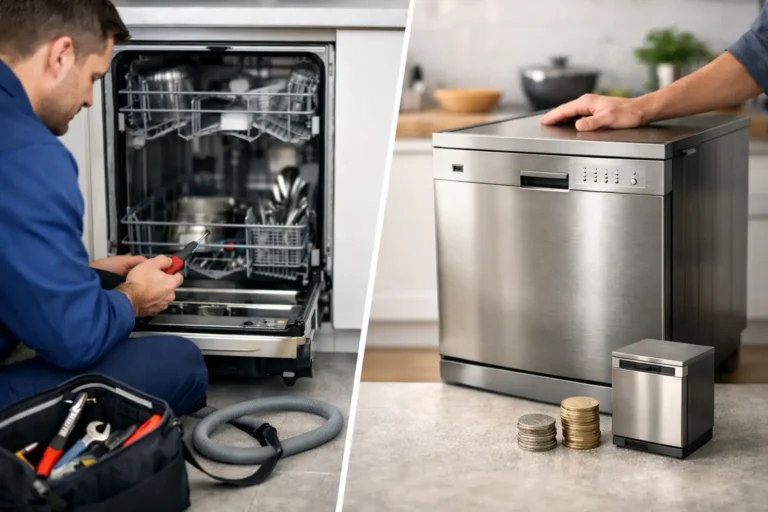
A washing machine stops mid-cycle, the oven starts heating unevenly, or the fridge freezer suddenly sounds louder than usual. Before you spend money on a repair or start shopping for a replacement, it helps to know how to check appliance age properly. Age does not tell you everything, but it gives you a much clearer idea of what a sensible next step looks like.
For most households, this matters when the fault appears without warning and time is tight. If you know an appliance is only four years old, a repair is often worth serious consideration. If it is pushing fifteen, the calculation changes. The good news is that you can usually find the answer yourself in a few minutes.
Why appliance age matters before you book a repair
The age of an appliance affects three practical decisions: whether repair is economical, whether parts are likely to be available, and whether the machine is nearing the point where repeat faults become more common. It is not a hard rule. Some premium appliances last well beyond average expectations, while some budget models can become unreliable earlier than expected.
Age also matters for landlords, tenants and busy households trying to avoid wasted call-outs. If a tumble dryer is relatively new, a fault may point to a single failed component rather than general wear. If an older dishwasher has already had previous repairs, you may decide not to keep investing in it. Knowing the age does not replace a proper diagnosis, but it gives the decision some structure.
How to check appliance age on the rating plate
In most cases, the quickest way to check appliance age is to find the rating plate or data sticker. This label usually includes the model number, serial number and electrical information. For many brands, the serial number contains a production date code.
The rating plate is not always in an obvious place. On washing machines, it is often inside the door frame or around the back. On dishwashers, check the top or side edge of the door when opened. Fridge freezers usually have it inside the cabinet, often behind a salad drawer or on an internal side wall. Ovens may have it on the frame behind the door, while tumble dryers often place it inside the door opening or on the rear panel.
Once you find the label, take a clear photo rather than trying to remember the numbers. That avoids mistakes and gives you something useful if you later speak to a repair engineer.
Model number vs serial number
The model number identifies the appliance type and version. The serial number identifies your specific unit. If you are trying to work out age, the serial number is usually the more important one because that is where brands often embed the manufacturing date.
That said, not every manufacturer uses the same format. Some put the year and week directly into the serial number. Others use coded letters and numbers that need decoding. A few provide no obvious date at all, which means you may need to rely on paperwork or professional verification.
Common ways manufacturers show the date
There is no universal appliance dating system, which is why people often get stuck. Still, most brands use one of a few common approaches.
Some serial numbers include the year and production week in plain numeric form. For example, a sequence may contain something like 2314, meaning week 14 of 2023. Others use the first digit for the year within a decade and the next two digits for the week. That can be less clear, because a 7 might mean 2017 or 2007 depending on the design and product range.
Some manufacturers use a letter for the month and a number for the year, or the other way around. Others build the date into a longer serial string that only makes sense with brand-specific decoding. This is where people often misread the data and assume the wrong age.
If the label shows a clear manufacture date, that is your answer. If it does not, avoid guessing from the appliance style alone. Stainless steel finish, digital displays or touch controls are not reliable indicators of age because many brands keep similar designs for years.
Other ways to check appliance age if the label is unclear
If the rating plate is damaged, faded or missing, you still have a few options. Start with the original purchase receipt, installer paperwork, user manual or warranty registration if you still have them. Even a bank statement or email confirmation can narrow the age down enough to guide your decision.
If the appliance came with the property, check documents from the previous owner, landlord or managing agent. In rented homes, inventory reports sometimes list make and model. For landlords, keeping a simple record of installed appliances saves time later when faults arise.
You can also check whether the appliance is still inside the manufacturer warranty period, if one was offered. That will not always tell you the exact production date, but it may confirm whether the unit is relatively recent.
How to check appliance age by appliance type
The process is broadly similar across brands, but the label location changes depending on the appliance.
Washing machines and washer dryers
Look inside the door opening first. If it is not there, check the rear panel. These appliances often have easily accessible data stickers, though built-in models can be harder to inspect without pulling them out.
Dishwashers
Open the door and inspect the top edge, side edge or the frame itself. Fully integrated dishwashers can hide their labels well, so a torch helps.
Fridge freezers and American-style fridges
Check inside the cabinet walls, behind the salad drawers, or near the lower compartments. Cooling appliances often keep the data plate inside rather than on the back. If the model is older, the sticker may be worn from moisture or cleaning.
Ovens and hobs
For electric ovens, inspect the frame visible when the door is open. Hobs may place the data plate underneath, which can make access difficult if fitted into the worktop. If you cannot see it safely, do not dismantle anything yourself.
Tumble dryers and coffee machines
Tumble dryers usually place the label inside the door area or on the rear. Coffee machines vary more, but many have a base label, rear label or data plate behind a service flap.
When age suggests repair is still worth it
A newer appliance with a single clear fault is often a good candidate for repair, especially if the rest of the machine is in sound condition. The same applies to better-built brands where parts remain available and the overall unit has years of service left.
Even an appliance at seven or eight years old may still be worth repairing if the issue is contained and previous performance has been stable. A failed pump, heating element, door lock or thermostat does not automatically mean the whole machine is finished. What matters is the fault, parts cost and general condition together.
This is also where transparent advice matters. A trustworthy engineer should tell you when a repair is sensible and when it is not, rather than pushing work that offers poor value.
When age points towards replacement
Older appliances become harder to justify when they show repeated faults, poor efficiency or signs of broader wear. If a ten to fifteen-year-old machine needs an expensive part and has already had previous issues, replacement may be the lower-risk option.
Parts availability is another factor. Some older models have discontinued components, and that changes the repair equation quickly. Cooling appliances can be especially sensitive here because specialist parts and refrigeration work may increase cost.
There is also the practical reality of disruption. If your washing machine is central to a busy family routine, repeated breakdowns can cost more in time and stress than a replacement would.
Mistakes people make when checking appliance age
The most common mistake is reading only the model number and assuming it gives the year. Usually it does not. Another is confusing the purchase date with the manufacture date. They may be close, but not always. Appliances can sit in stock before sale.
People also assume all brands use the same date code format. They do not. What works for one manufacturer may be completely wrong for another. And if the sticker is partly worn, it is easy to misread a 5 as an S or an 8 as a 3.
If you are using the age to decide on repair, accuracy matters. A small mistake can make an appliance seem much older or newer than it really is.
If you still cannot work it out
Sometimes the fastest option is to have the appliance assessed rather than spending an hour trying to decode a serial number. A qualified engineer can often identify the likely age range from the model details and confirm whether the machine is worth pursuing for repair. That is especially useful when the appliance is built-in, access is awkward, or you need a quick decision.
For households dealing with an urgent breakdown, appliance age is only one part of the picture. A proper diagnosis tells you more than the label alone ever can. But when you know roughly how old the machine is, you are already in a stronger position to make the right call.
If you are weighing up a repair in West London and the numbers on the sticker are not giving you a clear answer, keep the model and serial details to hand. It makes the next conversation much quicker, and it helps turn a stressful fault into a straightforward decision.