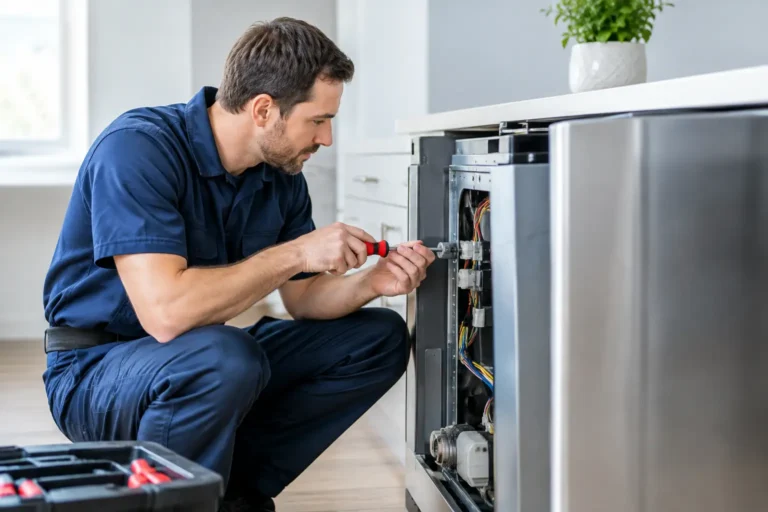
A Miele washing machine repair example is often the clearest way to understand what has actually gone wrong, how a proper diagnosis is made, and whether a repair is worth booking. For most households, the problem starts with something simple – the drum will not turn, the cycle stops mid-wash, or the machine shows a fault code and refuses to continue. What matters next is not guesswork. It is accurate diagnosis, a clear quote, and a repair that solves the fault properly.
A realistic Miele washing machine repair example
One of the more common call-outs involves a Miele washing machine that powers on normally, locks the door, takes in water, and then stops before the drum begins to rotate. To the customer, it can look like a motor failure. In practice, that is only one possibility.
In a real repair scenario, the first step is to confirm the machine’s sequence. If it fills and drains correctly but never starts tumbling, the engineer would usually test the motor circuit, carbon brushes where applicable, wiring continuity, control board output, and drum resistance. On some Miele models, the issue may sit with the motor itself. On others, the fault is caused by a worn component in the drive system, a damaged loom, or a failed electronic control module.
That difference matters because replacing the wrong part wastes time and money. A good repair is not based on the loudest symptom. It is based on proving the fault.
What the diagnosis often looks like
Let us take a practical example. The customer reports that the machine completes short parts of the cycle but leaves clothes soaked and occasionally flashes an error before stopping. There is no obvious leak, and the door still locks correctly.
On inspection, the drain pump may be clear and working, the inlet valves may test normally, and the suspension may still be sound. The engineer then checks whether the drum can rotate freely by hand, whether the motor is receiving the correct command, and whether the tachometer feedback is being read properly by the control board. If the motor tries to start and cuts out repeatedly, that points in one direction. If there is no output signal at all, it points in another.
In one typical Miele repair example, the underlying issue is a failed motor carbon brush set on an older machine. The appliance still has power, still fills, and still appears half-functional, but the motor cannot maintain proper contact. Replacing the brushes, testing the commutator condition, and running a full cycle check can return the machine to normal service without the cost of major parts.
On newer brushless models, the same symptom could lead to a very different repair path. That is why brand knowledge matters.
Why Miele faults need careful diagnosis
Miele machines are generally built to a high standard, which is exactly why rushed diagnosis can be misleading. These appliances often continue to perform some functions even when a key component is failing. A lower-grade machine might fail completely and make the fault more obvious. A Miele often does not.
That can create two common mistakes. The first is assuming the machine needs replacing because the behaviour seems inconsistent. The second is ordering parts based on an online fault code list without checking the appliance properly.
Fault codes can help, but they are not a full diagnosis. The same code may relate to a blocked drainage path, a sensor issue, wiring damage, or a board problem. The code tells you where to investigate. It does not always tell you what to replace.
Repair or replacement – what makes sense?
This depends on the age of the appliance, the exact fault, and the overall condition of the machine. Miele washing machines are usually worth repairing when the cabinet, drum bearings, suspension, and main structure are still in good order. If the issue is a pump, door lock, heater, valve, brush set, sensor, or some control-related fault, repair is often the sensible option.
If the machine is very old and facing multiple high-cost failures at once, the decision becomes less straightforward. For example, a control board issue on its own may still be worth repairing on a premium appliance. But if that same machine also has worn bearings, severe corrosion, and a damaged drum spider, the maths changes.
The honest answer is that it depends. Any reliable engineer should say so.
Another Miele washing machine repair example – not draining
A second common Miele washing machine repair example involves a machine that washes normally but stops before the final spin because it cannot drain. The customer may hear humming, find water left in the drum, or notice that the cycle time runs far longer than expected.
The obvious suspicion is a blocked pump, and sometimes that is exactly what it is. Coins, hair grips, fabric fibres, and small clothing items can all obstruct drainage. But drainage faults can also come from a damaged pump impeller, a restriction in the sump hose, a pressure system issue, or a control problem that fails to trigger the drain sequence correctly.
A proper diagnosis would include checking the filter housing, pump operation, hose condition, pressure chamber, and electrical readings under load. If the pump is receiving voltage but not moving water effectively, replacement may be the right repair. If the pump is healthy but the machine falsely reads the water level, the repair could involve a different component entirely.
This is where many customers understandably become cautious. They want to know the likely cost before committing. That is reasonable. The right approach is a fixed quote after diagnosis, not vague estimates that change once the machine is opened.
What customers should expect from a proper repair visit
A professional repair visit should feel organised from the start. That means a booked arrival window, a clear explanation of the likely fault path, and straightforward pricing once the diagnosis is complete. If parts are needed, you should know what is being fitted and why.
For a premium brand such as Miele, genuine or quality-approved parts matter. Cheap substitutes can create repeat faults, poor wash performance, or premature failure elsewhere in the machine. Saving a small amount on the part often costs more later.
Testing is just as important as replacement. A machine should not simply be switched on and declared fixed because the drum rotates for ten seconds. A proper post-repair check should confirm filling, heating where relevant, draining, spinning, and overall cycle behaviour.
That level of care is especially valuable for busy households in West London, where losing the washing machine for several days quickly becomes disruptive. Reliable service is not only about repairing the appliance. It is about reducing downtime and removing uncertainty.
Common Miele washing machine faults that look similar
One reason repairs can be misjudged is that different faults present in almost identical ways. A machine that stops mid-cycle might have a drainage problem, a heating issue, a motor fault, or a control board interruption. A failure to spin could be linked to an unbalanced load system, a blocked drain path, worn motor components, or sensor errors.
That is why symptom-based internet advice has limits. It can be useful for checking simple issues such as a blocked filter, a trapped drain hose, or a child lock setting. Beyond that, assumptions become risky.
If there is a burning smell, repeated tripping of the electrics, visible leaking, or signs of overheating, it is sensible to stop using the appliance until it is inspected. Continuing to run it can turn a repairable fault into a more expensive one.
Is a same-day repair realistic?
Sometimes yes, sometimes no. If the issue is a common service part and the fault is straightforward, same-day repair can be realistic. If the machine requires a less common Miele-specific component, there may be a short wait for the correct part.
What matters is transparency. Customers are usually patient when the explanation is clear and the diagnosis is credible. What they do not want is uncertainty, missed appointments, or changing prices. That is exactly why many choose an established local specialist rather than taking a chance on an unverified repairer.
The value of an example before you book
A clear repair example helps because it shows how the process should work. The machine presents a symptom, the fault is tested rather than guessed, the customer is given a fixed price, and the repair is checked properly before the job is signed off. That is the standard people should expect.
For Miele appliances especially, repair is often worthwhile when the diagnosis is thorough and the machine has plenty of service life left. A premium washer that is repaired properly can continue performing well for years. A rushed or inaccurate fix usually leads to another call-out.
If your Miele washing machine has stopped working as it should, the most useful next step is not hunting for a universal answer. It is getting the fault identified properly so you can make a calm, informed decision based on the actual condition of the machine.